Art@Resonate

Your guide to all those paintings

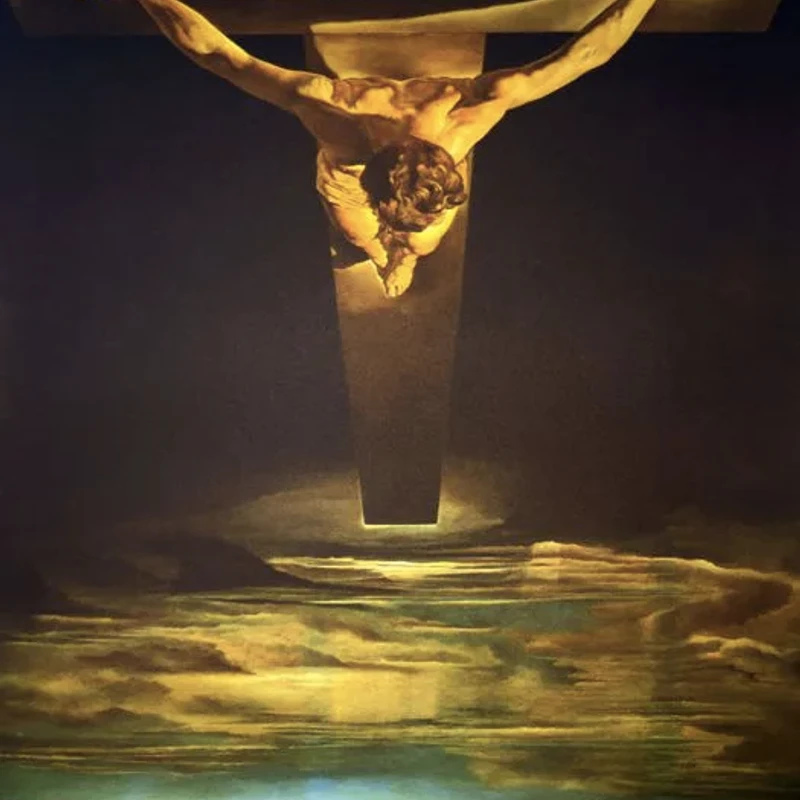
Painting by Salvador Dalí depicting Christ on the cross from an overhead perspective, floating above a dramatic, cloud-filled waterscape with fishermen below.

Christ of St John of the Cross

Salvador Dalí Summer 1951 Oil on canvas

Painted in the summer of 1951, this crucifixion reimagines the Passion from an impossible, aerial viewpoint—inviting worshippers to contemplate the mystery from “above,” as it were. The composition draws on a dramatically foreshortened crucifixion sketch by the Carmelite mystic St. John of the Cross; the painter later said the encounter sparked a dream and an immediate resolve to paint Christ in that angle. The result is strikingly non-graphic: no nails, blood, or crown of thorns, and Christ’s face is hidden, tilted toward a dark sea and the small fishing boats below. Now housed at the Kelvingrove Art Gallery and Museum, the work belongs to “nuclear mysticism,” presenting Christ as the cosmic center that holds creation together—suffering transfigured into quiet majesty.
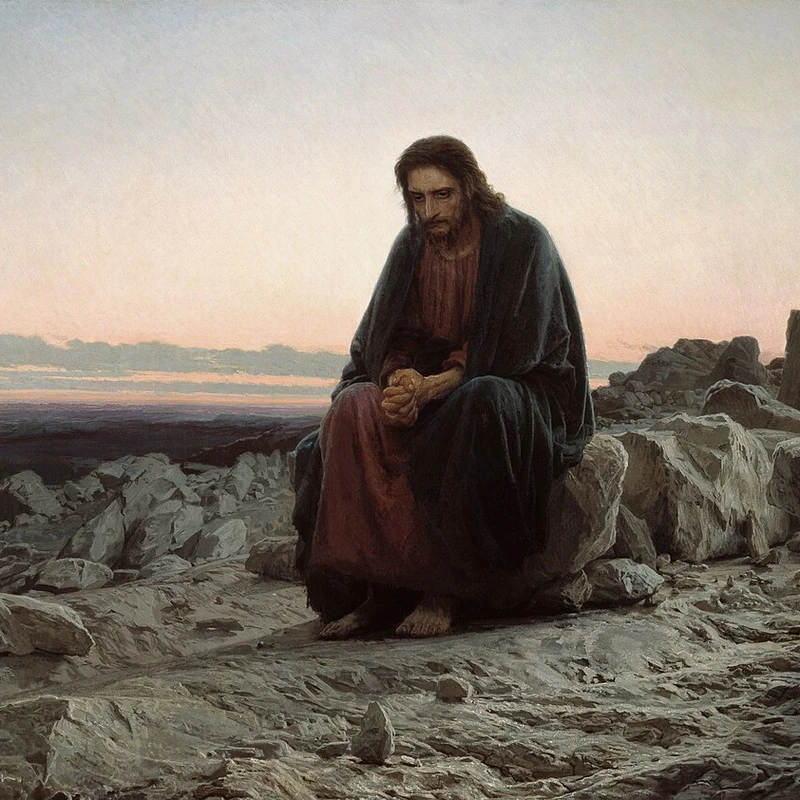
A painting of Jesus Christ sitting barefoot on a rock in a desolate, rocky landscape at dawn, looking down with a somber, contemplative expression.

Christ in the Wilderness

Ivan Kramskoi — 1872 — Oil on canvas This 1872 canvas places Christ not in dramatic confrontation with the tempter, but in the silence after long struggle. Seated on a cold rock at daybreak, Jesus folds his hands and hunches forward, his face drawn and resolute—the desert rendered as a stark, stony emptiness that offers neither comfort nor distraction. The horizon line sits low, giving the figure weight and solitude; the subdued palette and tight composition turn the scene into a study of interior prayer and decision. Painted within Russian Realism’s renewed attention to psychological truth, the work entered Pavel Tretyakov’s collection and remains a centerpiece of the State Tretyakov Gallery. In a sanctuary, it steers meditation toward Christ’s humanity: temptation as persevering, wordless fidelity.

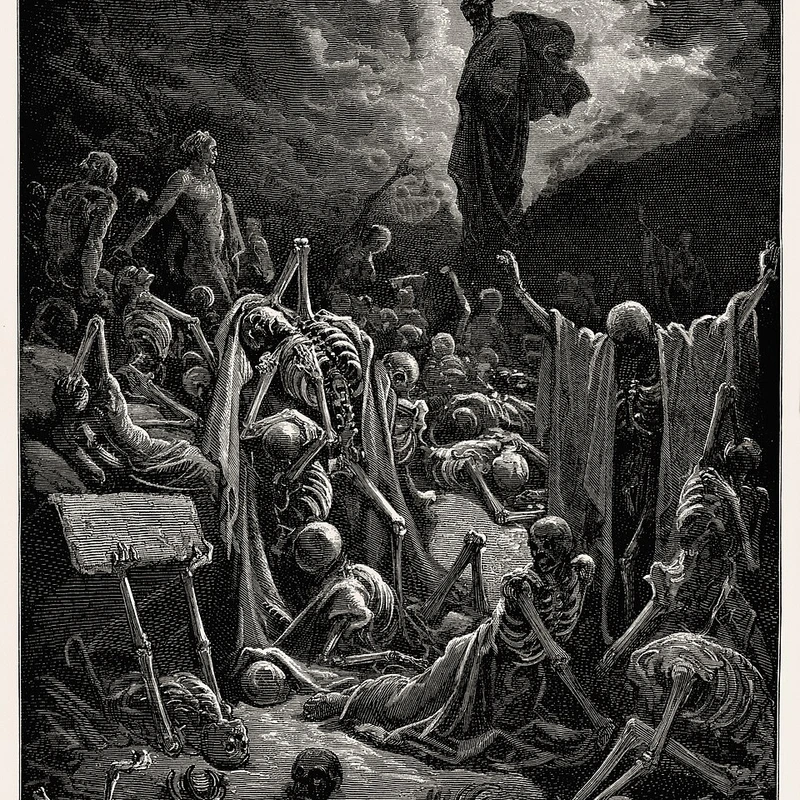
A black-and-white engraving of a robed prophet on a hill, overlooking a valley where skeletons are rising and coming back to life under a crescent moon.

The Valley of Dry Bones

Gustave Doré — 1866 — Wood engraving (Bible illustration) This dramatic Bible illustration of Ezekiel 37 visualizes promise in the midst of devastation. Across a valley strewn with bones, the prophet stands silhouetted against a luminous sky as skeletal figures begin to rise—translating Ezekiel’s prophetic question (“Can these bones live?”) into a scene of sudden, unsettling motion. The image was designed as a wood-engraving for a deluxe illustrated Bible edition first issued in 1866 and reproduced worldwide thereafter. Sweeping contrasts of darkness and light—crowded foreground detail against a single, radiant opening above—make the vision both terrifying and hopeful: God’s life-giving breath reaches what seems beyond repair. In a sanctuary context, the print naturally reads as Paschal: exile turning toward resurrection.

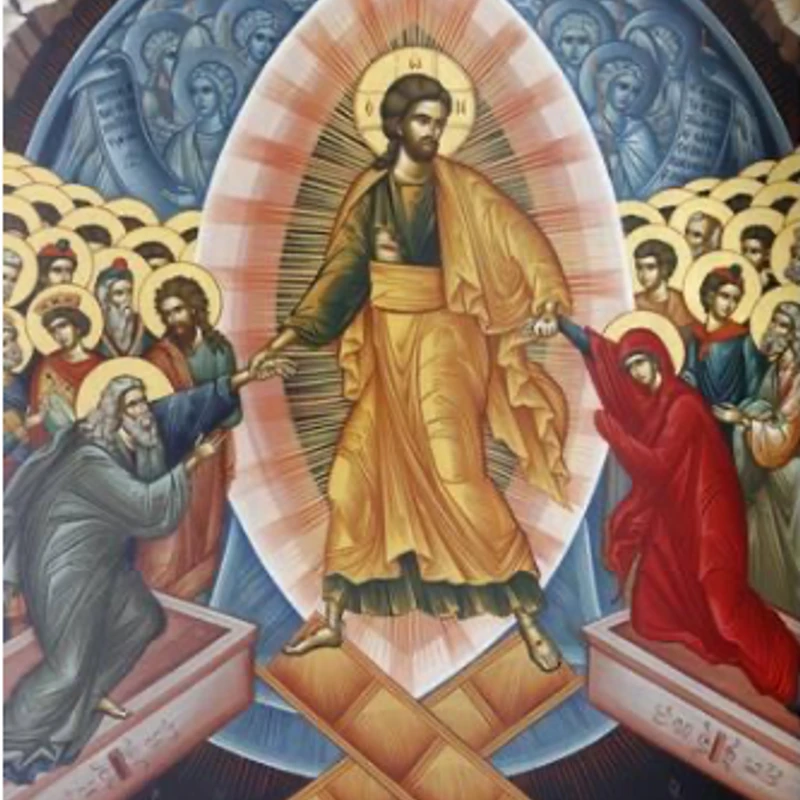
An Orthodox icon depicting the resurrected Christ, standing on the broken gates of Hell, pulling Adam and Eve from their tombs, surrounded by saints and angels.

Resurrection Icon

Tirana, Albania — Unknown Albanian iconographer — 17th century (attributed) — Painted icon (medium unknown) This Resurrection icon follows the Eastern Christian image of the Anastasis—Christ’s victorious descent into Hades. At the center, the risen Christ stands in a radiant mandorla and pulls Adam and Eve from their tombs, while the broken gates beneath his feet fall into the shape of a cross, proclaiming that death itself has been trampled down. The surrounding ranks—prophets, kings, and the righteous—form a liturgical “witness” to the event, echoing the Church’s Paschal proclamation that Christ frees humanity from captivity. Image libraries identify the Tirana exemplar as a 17th‑century icon, with the painter unrecorded; its power lies less in individual authorship than in fidelity to a prayed tradition, meant to be read with the mind and heart as much as the eyes.

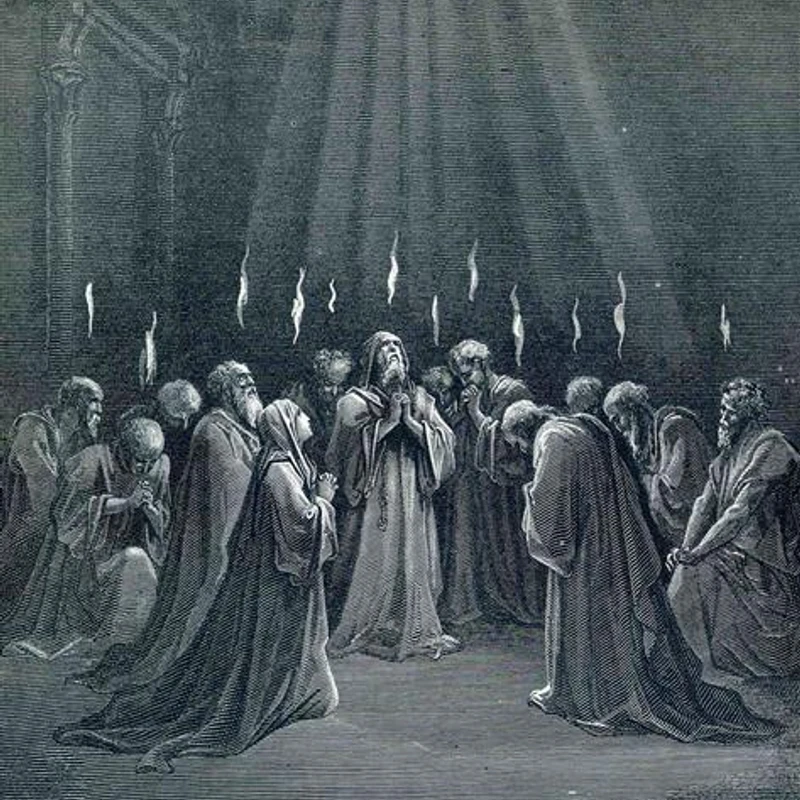
A black and white engraving showing the Apostles and Mary kneeling as a dove descends in a beam of light, with tongues of fire appearing above their heads.

Decent of the Spirit

Gustave Doré — 1866 — Wood engraving (Bible illustration) In this Pentecost scene, a celebrated nineteenth-century Bible illustrator translates Acts 2 into a single surge of descending light. The apostles gather below as a dove and radiant beam pour from above, and “tongues” of flame hover over each head—visual shorthand for the Spirit’s gift of speech, courage, and communion. Designed as a woodcut for an illustrated Bible first published in 1866, the composition uses deep architectural shadows to throw the divine illumination into sharp relief. The crowding of figures emphasizes that Pentecost is not a private mystical experience but the formation of a people: many faces turned upward, many gifts received, one Church born. Displayed in a sanctuary, the image pairs naturally with music and proclamation, reminding viewers that the Gospel is meant to be heard—and carried outward.

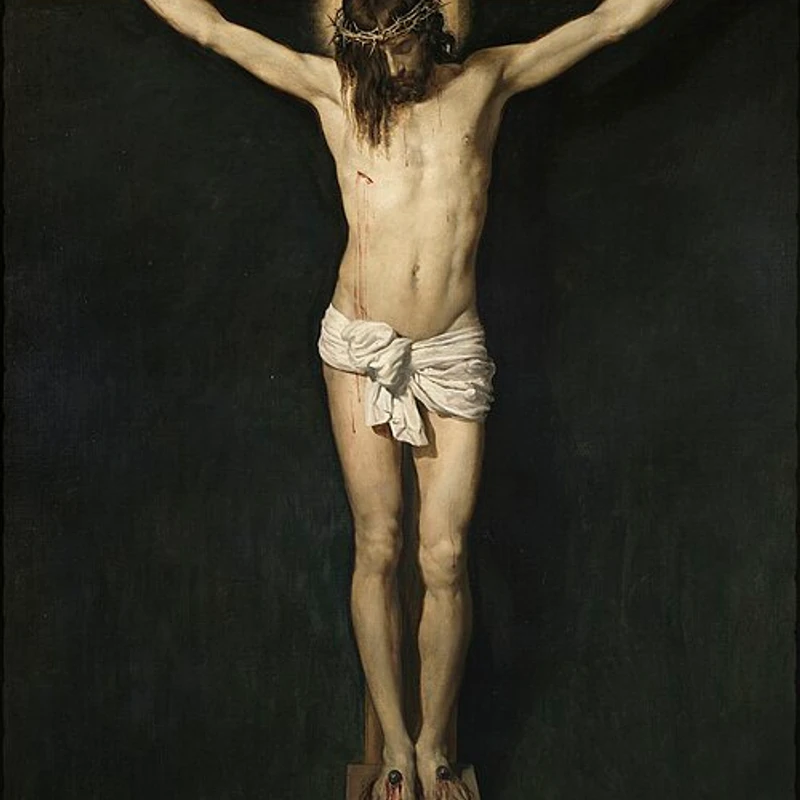
A realistic painting of Jesus Christ on a wooden cross against a solid dark background. He wears a crown of thorns and a white loincloth, with wounds visible.

Christ Crucified (Cristo crucificado)

Diego Velázquez — c. 1632 — Oil on canvas This Spanish Baroque masterpiece, Cristo crucificado (c. 1632), distills the Crucifixion to a single, monumental figure against a deep, quiet ground. The body is rendered with classical balance and luminous restraint—a calm that intensifies, rather than softens, the reality of death. Following the Spanish devotional debate of the period, the painter depicts four nails, an iconographic choice advocated by his teacher and father‑in‑law Francisco Pacheco; the titulus above Christ’s head follows the Vulgate wording, and the anatomy is studied with extraordinary precision. The Museo Nacional del Prado notes that the painting was likely commissioned for the convent of San Plácido and is generally dated around 1632. In a sanctuary, its silence becomes catechesis: holiness shown not through excess, but through reverent, contemplative truth

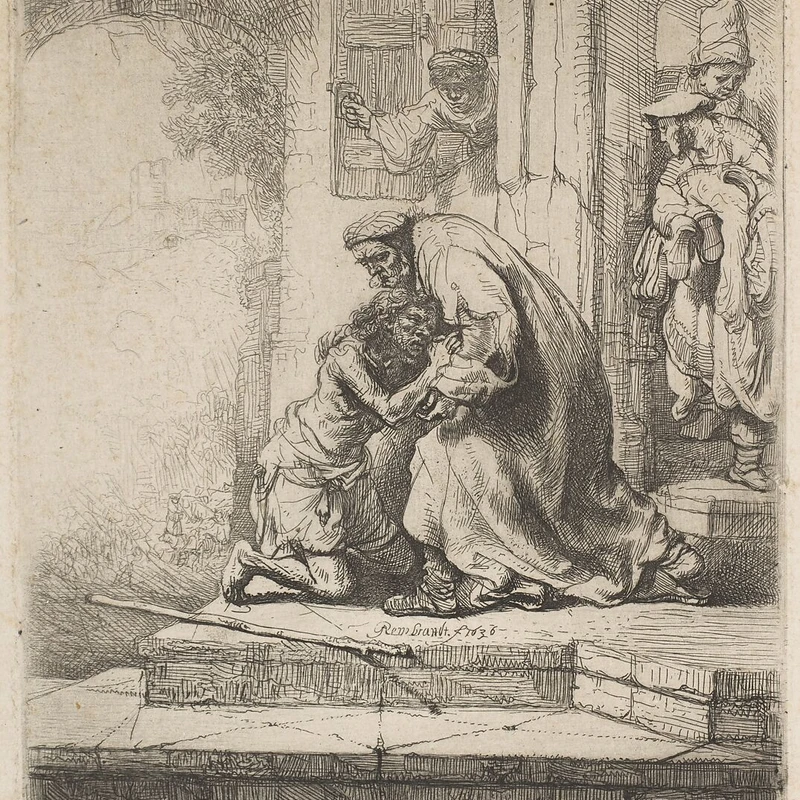
A black and white etching where an old man in robes embraces a kneeling, ragged young man on stone steps. Other figures watch from a doorway and window.

The Return of the Prodigal Son

Rembrandt van Rijn — 1636 — Etching (print) This 1636 etching of the Prodigal Son captures reconciliation as an event at the threshold. The father embraces the ragged, kneeling son at the doorway, while servants hurry forward with fresh clothes—an economy of lines that makes mercy feel immediate and bodily. Unlike later, more interiorized treatments of the parable, this print is animated by movement: hands reaching, garments arriving, the home opening again to the one who “was lost and is found” (Luke 15). Museum catalogues describe the scene explicitly as the father’s welcome and the bringing of new clothing, and the plate bears the artist’s signature and date. In a sanctuary, the work functions as a visual confession: repentance is real, but it is met first by the father’s initiative—an embrace before any speech.

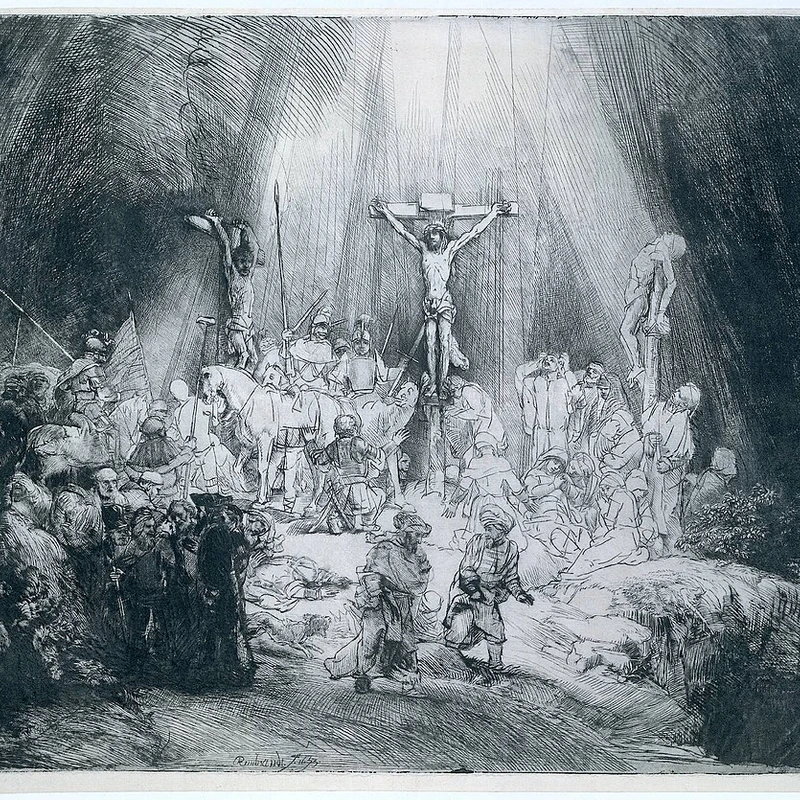
A dramatic black and white etching by Rembrandt showing the crucifixion of Jesus and two others, surrounded by a large crowd under a beam of divine light.

Christ Crucified between the Two Thieves (The Three Crosses)

— Rembrandt van Rijn — 1653 — Drypoint (print) In The Three Crosses (1653), the Crucifixion becomes a storm of light and darkness. Working largely in drypoint, the artist draws Christ as the single clear vertical amid a crowd that is partly swallowed by shadow. Catalogues note that the plate was later reworked with slashing strokes that obscure earlier spectators and deepen the tenebrous setting, focusing attention on Christ bathed in celestial light. They also emphasize the printmaker’s unusually creative inking—sometimes leaving a veil of ink on parts of the plate—so that impressions can feel almost “painted,” with velvety burr and softened passages; some were even printed on vellum, which holds ink on the surface and warms the image. The technique becomes theology: darkness presses in, yet light remains. For a sanctuary, the work invites lingering at the cross when comfort and certainty dim.

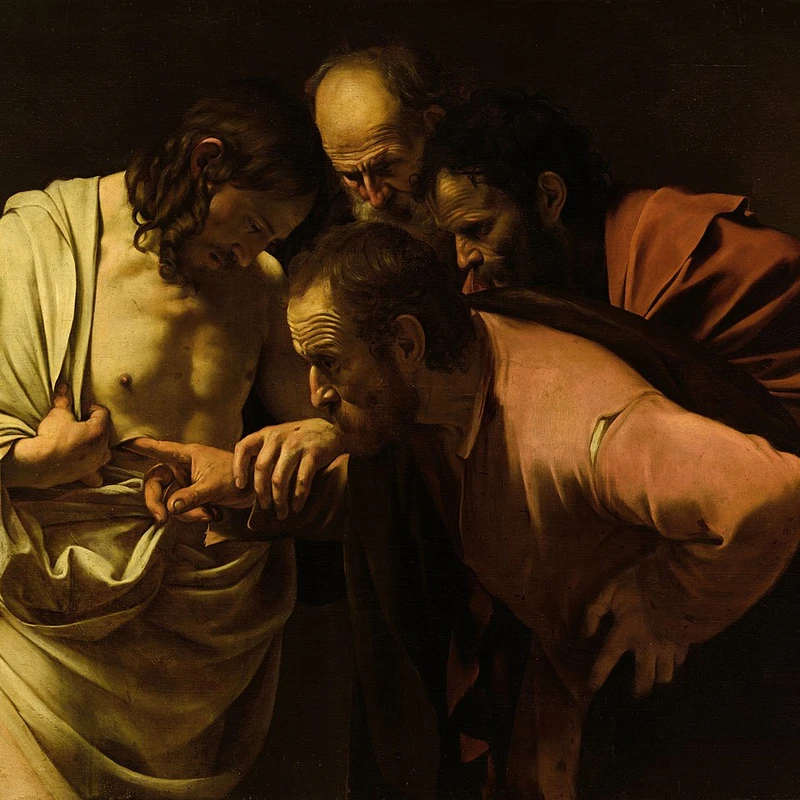
A Baroque painting showing Jesus guiding the finger of the apostle Thomas into the wound in his side as two other apostles look on with intense expressions.

The Incredulity of Saint Thomas

Caravaggio — c. 1601 — Oil on canvas This early-seventeenth-century painting stages doubt not as stubbornness but as wounded hope seeking contact. Christ guides Thomas’s hand into the open side wound while two other disciples lean in, their furrowed brows and close clustering making the scene feel almost breathless. The work’s chiaroscuro—figures emerging from a near-black ground—forces attention onto flesh, gesture, and the small, shocking point of touch. Held today in the Picture Gallery Sanssouci, it is catalogued as oil on canvas and dated around 1601. In a sanctuary, the image can be read as an icon of sacramental realism: faith is not mere idea, but encounter—Christ offering his wounds as the place where disbelief is healed.

A biblical painting of a large crowd at a hillside tomb. In the foreground, women mourn and walk away, while a Roman soldier and others look on.

What Our Lord Saw from the Cross

James Tissot — 1886–1894 — Opaque watercolor over graphite on paper This watercolor reorients the Crucifixion by reversing the usual viewpoint of Calvary. Instead of looking up at Christ, the viewer looks down with him: the crowd, soldiers, and disciples spread out below, while only Christ’s feet appear at the bottom edge—an unsettling reminder that the crucified is also the unseen seer. The Brooklyn Museum notes that the artist created the work as part of an ambitious New Testament cycle and describes it as an unusually “innovative” crucifixion image, shaped by a late-life turn toward spiritual subjects. Executed in opaque watercolor over graphite, the scene compresses drama into human faces: grief, curiosity, hardness, devotion. In a sanctuary, the composition invites examen: if this is what Christ saw, where would we be standing?

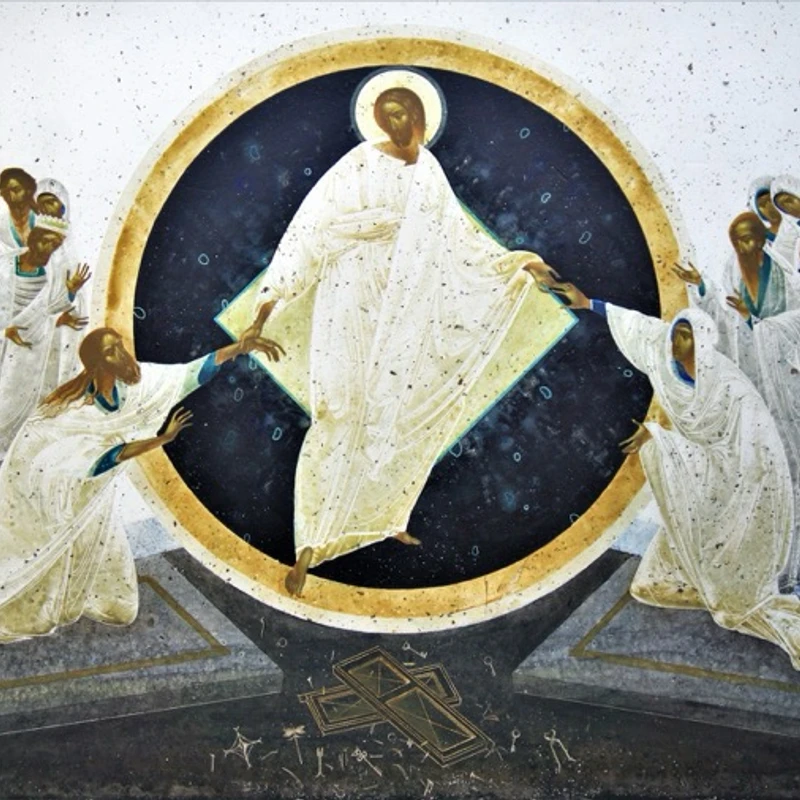
An Eastern Orthodox icon of the Resurrection. Christ, in white, stands in a central halo, pulling Adam and Eve from their tombs over the broken gates of Hades.

Appearance of Christ to the Myrrh-Bearers

Ivanka Demchuk — c. 2014 — Tempera and acrylic on board This contemporary icon reinterprets the Resurrection through the Gospel tradition of Christ’s appearance to the myrrh-bearing women (Matt. 28:9–10). The composition is spare and modern: a nearly monochrome, textured ground suggests a world still hushed—almost unmade—after the trauma of Good Friday. Against it, the risen Christ advances in white, enclosed by a round mandorla that reads as both halo and cosmos, while the women approach with ointment jars, their gestures a mixture of fear, adoration, and dawning recognition. The artist’s portfolio identifies the subject (“Appearance of Christ to the Myrrh‑Bearers”) and records the use of tempera and acrylic on board; a 2014 ICONART exhibition text places this scene within the traditional “forty days” cycle of post‑Resurrection appearances. In a sanctuary, the work speaks hope without triumphalism: light arriving gently, in the middle of ordinary grief.